|
|
What benefits are there to using handmade soap over commercial soap?
'Soap' is defined as a substance used for washing and cleansing purposes - a compound of natural oils or fats treated with sodium hydroxide (lye). Take a look at the ingredients on the back of most store-bought soap. Rarely are these 'soaps' made by treating fats or oils with lye, rather, they are a chemically synthesized detergent with artificial fragrances and colours derived primarily from petroleum (sometimes there is actual soap in there too). These substances clean in a similar way: they break down the resistance barrier between the water and the dirt, grime, oil, or other material, allowing it to be wetted and washed away. However, the plethora of ingredients in commercial soaps can have very damaging, irritating, drying effects on the skin, not to mention the fact that the skin is receptive and absorbent, and any products that come in contact with the skin are absorbed in to the blood stream. Let's look at a few of these ingredients:
'Soap' is defined as a substance used for washing and cleansing purposes - a compound of natural oils or fats treated with sodium hydroxide (lye). Take a look at the ingredients on the back of most store-bought soap. Rarely are these 'soaps' made by treating fats or oils with lye, rather, they are a chemically synthesized detergent with artificial fragrances and colours derived primarily from petroleum (sometimes there is actual soap in there too). These substances clean in a similar way: they break down the resistance barrier between the water and the dirt, grime, oil, or other material, allowing it to be wetted and washed away. However, the plethora of ingredients in commercial soaps can have very damaging, irritating, drying effects on the skin, not to mention the fact that the skin is receptive and absorbent, and any products that come in contact with the skin are absorbed in to the blood stream. Let's look at a few of these ingredients:
|
Sodium Lauryl Sulfate A
synthetic substance used in many “natural” shampoos and soap for its detergent
and foaming properties. Can causes eye irritations, skin rashes, hair loss,
scalp conditions similar to dandruff, allergic reactions.
Fragrance (parfum) Immune system toxicant; possible neurotoxin; can contain between 10 and 300 different chemicals; can cause headaches, dizziness, rashes, etc. Propylene Glycol Usually a synthetic petrochemical mix used as a humectant, it has been known to cause allergic and toxic reactions. Tetrasodium EDTA has been found to be both cytotoxic (toxic to cells) and weakly genotoxic (toxic to genetic material) in laboratory animals. Yellow 5, Blue 1, Red 33 dyes suspected of being carcinogenic and are banned in many countries, however not in the US or Canada. For most of the remaining ingredients, there is either very little data available regarding safety or testing or they are assumed harmless. |
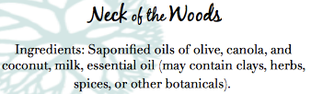
Example of ingredients in a handmade bar of soap
|
You should also be aware that the government does not actually regulate what the term “natural” means in your personal care products, so commercial soaps, shampoos, creams, etc. can claim to be “natural” while still being primarily synthetically derived. Even some "handmade" soaps are actual made by purchasing what is called 'melt-and-pour' soap base from soap supply companies that the soapmaker then melts down, adds scent and/or colour, and remolds. This soap often contains Sodium Laureth Sulfate, Propylene Glycol, and other questionable ingredients.
So, the bottom line is, quality handmade soaps are made from oil and lye (and if you're lucky, milk!), and help remove oil and dirt from the skin's surface without irritating or drying. That's the benefit to you as well as the environment, and the additional plus is keeping your dollars local in your community - rather than giving them away to corporations - when you purchase products from local craftspeople!
So, the bottom line is, quality handmade soaps are made from oil and lye (and if you're lucky, milk!), and help remove oil and dirt from the skin's surface without irritating or drying. That's the benefit to you as well as the environment, and the additional plus is keeping your dollars local in your community - rather than giving them away to corporations - when you purchase products from local craftspeople!
Are your soaps made with lye? Is it dangerous?
Soap is not soap if it is not made with lye. A cleaning product that was not created by the treatment of fats or oils with lye (sodium or potassium hydroxide) is not soap, by definition! Lye is only dangerous in raw form. It is a strong alkali that can burn similar to an acid burn. Soap generally takes 4-8 weeks to fully cure; the first 48 hours it is recommended not to touch your skin. After that you could hold it with your bare hands, and after about 5 days it is completely safe to wash with (or even consume) as the chemical reaction between the fats and lye has 100% denatured the lye. The remainder of the curing period is for moisture release to harden the bar.
How can I prolong the life of my handmade soap?
The number one way to keep your handmade soap lasting is to keep it dry! Soap is meant to disintegrate when wet, so use it, then remove it from the shower, or keep it propped up on a dish or brush so it can dry. The shelf life of Neck of the Woods soaps is about a year and a half, but scents will fade over time.
Is there glycerin in your soaps?
Yes, but it is not added. In all cold-processed, from-scratch soap making, glycerin is a by-product. Glycerin is a colorless, odorless, viscous liquid used as a means of improving smoothness, providing lubrication, softening, and as a humectant in the cosmetic industry, but occurs naturally in soaps. When the sodium hydroxide (NaOH) or lye, combines with the fats (glycerol molecule with three fatty acid chains) in a soap recipe, long-chain carboxylate salts (soap) are formed between the lye and fatty acid chains, and water, excess fat, and glycerol (glycerin) remain.
Why not palm oil?
While many soap companies use palm oil as a main ingredient due to the economy of price, palm oil plantations are the number one cause of rainforest deforestation in Indonesia and Malaysia. These giant monoculture crops destroy soil fertility, rainforest propagation, and wildlife habitat. Neck of the Woods has chosen to avoid the use of palm oil for all primary products and soaps, and only uses palm oil in a 7% contribution to our shaving bar as it, combined with 20% castor oil, gives a remarkable, unique, shaving cream-like lather.
Considered organic?
Yes, working on it! Again, as volume increases we are hoping to shift to organic :)
